Instruction Request Intake & Triage Assistant
Rationale
Academic librarians often receive instruction requests that vary widely in quality, completeness, and scheduling feasibility. This AI-assisted workflow standardizes the intake process, evaluates request clarity, checks calendar availability, and prepares actionable recommendations so librarians can spend less time on administrative triage and more time designing effective instruction.
What it does
- Captures faculty instruction requests submitted through a Google Form
- Organizes each request into a centralized Google Sheet
- Uses OpenAI to generate an Instruction Planning Summary tailored for librarians
- Classifies requests as Accepted or Needs Review based on assignment clarity
- Performs a Google Calendar availability assessment for the requested session date
- Recommends the librarian's next action based on both the triage decision and calendar assessment
- Drafts a personalized follow-up email that can be sent directly to the faculty member
- Updates the request record with AI-generated outputs for future reference and reporting
How it fits
This workflow serves as the front door of the library instruction process. It combines AI-powered instructional analysis with workflow automation and calendar integration to transform raw faculty requests into structured, actionable records that support instructional planning while keeping librarians in control of final decisions.
Setup & use
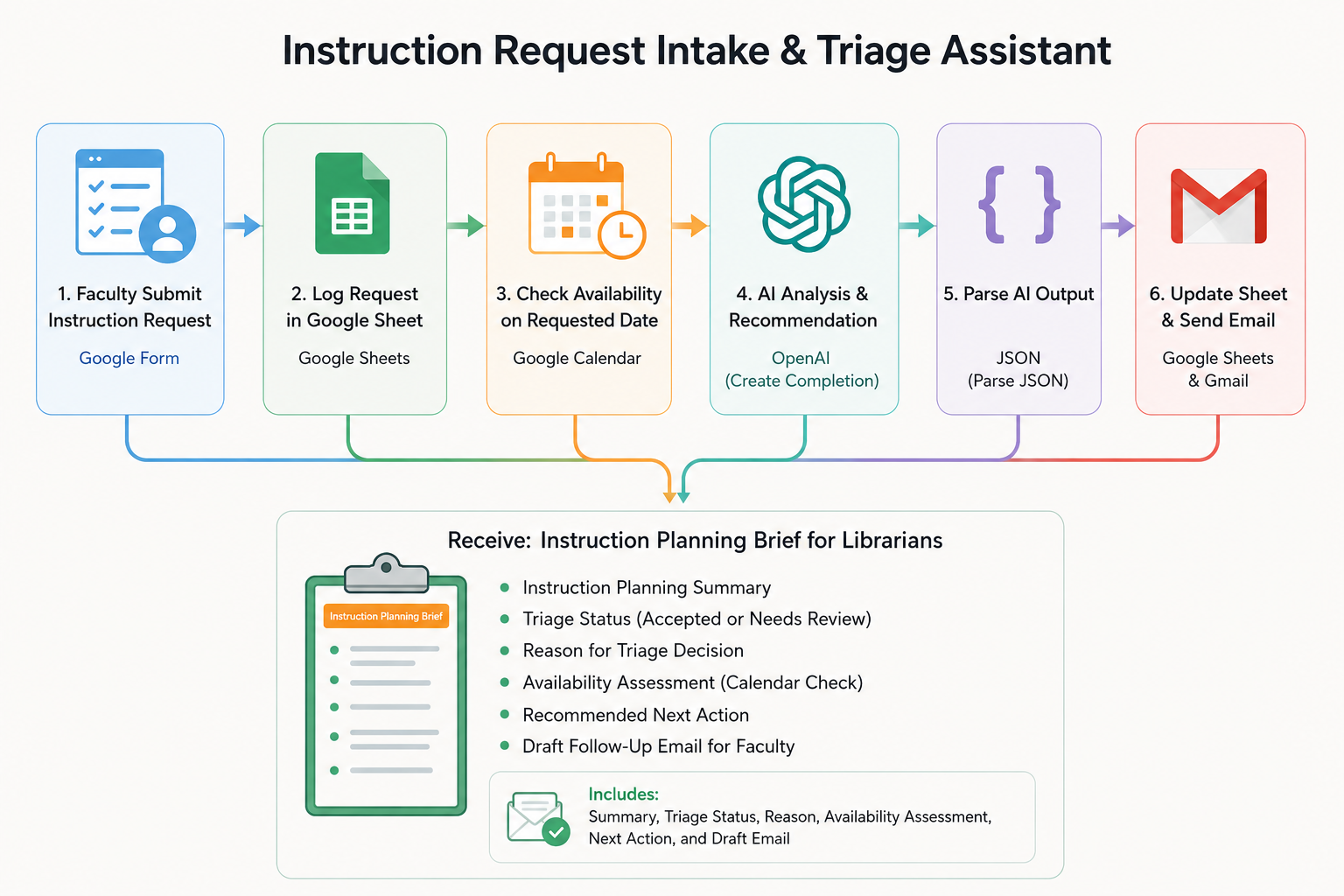
- 1Faculty submit an instruction request through a Google Form.
- 2The request is logged to a Google Sheet.
- 3Google Calendar checks for existing events on the requested session date.
- 4OpenAI generates an Instruction Planning Summary, determines the triage status, recommends the next action, and drafts a follow-up email using both the request details and calendar assessment.
- 5The Google Sheet is updated with the AI-generated outputs.
- 6The librarian receives an email containing the planning summary, triage decision, calendar assessment, recommended next action, and draft faculty response.
The goal is not to automate instructional decisions. The system automates intake, organization, and preliminary evaluation so librarians can focus their attention where professional judgment is most needed.